
Photo by Spencer Chow on Unsplash
¡Hola! And welcome back to GEN33, a newsletter about the business and culture of Latin America’s creative industries. I hope you enjoyed some time off over the holidays. I’m in Barcelona this week and was hoping to escape London’s grey, rainy skies, but nature had other plans: days of a levante storm, flooding and chaos. Thankfully we're ok!. Time to get a vitamin D supplement though.
2025, what a year it's been! Latin America is facing significant political division and tension, further exacerbated by everything the ‘orange tenant’ in the White House does. This doesn’t escape the creative industries, clearly. His administration’s strict immigration measures have hit Latino communities in the US especially hard, affecting everything from art fairs to music concerts. Meanwhile, new policies and tariffs have redrawn fashion and textile trade maps and reshaped the region’s outlook on tech.
For this issue, I had set out to cover several topics and, predictably, fell down a few rabbit holes (thanks ADHD!). So rather than cramming everything into one issue, I’ve narrowed this one to art.
While I get that many artists dream of exhibiting in Europe or the U.S., regional art fairs play a crucial role in increasing the visibility of Latin American art and what it stands for. This feels especially important as many artists, often living in exile, explore themes of belonging, displacement and identity.
Full disclaimer: I’m far from an art expert and won’t pretend to be. However, the fact that I largely agree on this recent list of The Worst Artworks of 2025 suggests I may not be entirely clueless.
In any case, my aim with this issue is to bring you a set of stories artists and entrepreneurs I found genuinely positive and inspiring. May these glimpses of art offer a spark of joy and hope, even as the world keeps spinning in chaos.
Mentioned in this issue: Adriano Pedrosa, Fernanda Feitosa, Luciano Giménez, Silvana Trevale, Juliana Sorondo, Gabriel Pinto, Ernesto Neto, Irene Gelfman, Suwon Lee, María Elena Pombo, Luis Rentería, Antonela Aiassa, Armando Mesías, Angyvir Padilla, Emiliana Henríquez, Miranda Makaroff, Cecilia Vicuña, Olga de Amaral, Cossette Zeno and more.
Table of Contents
Art in 2025
SP-Arte draws increased interest from international collectors and curators

Latin America’s biggest art fair, SP-Arte, has seen renewed international interest in Brazilian art, according to its founder, Fernanda Feitosa. (The Art Newspaper). This was partly driven by the increased visibility generated by Adriano Pedrosa, artistic director of the São Paulo Museum of Art (MASP), through his role as curator of the 2024 Venice Biennale. Pedrosa is widely acclaimed for his rigorous and thought-provoking curatorial work.

Galatea Gallery at SP-Arte
Feitosa said collectors and museum representatives are returning to São Paulo after many years of global attention tilted towards Asia. “Eighty foreigners contacted us and that is almost triple the number of foreign collectors and curators we had in the past few editions,” she said. The event, founded in 2005, featured around 200 exhibitors.
A key market signal this year is the growing demand for women artists, with strong attention on works by Marina Rheingantz, Lygia Pape and Adriana Varejão.
ArteBA 2025 pressed ahead amid Argentina’s broader economic crisis.

Image Fundación Arteba
The contemporary art fair, one of Latin America’s largest, secured increased institutional backing and sponsorship to stage this year’s edition against the country’s complex economic climate. According to the Argentine newspaper Clarín, the event's lead-up saw intense internal debate, with several established galleries notably absent.
Held in August, ArteBA brought together 67 galleries and over 400 artists from Argentina and abroad. Some participants included Mariano Ulloa, Bernabé Arévalo, Antonio Berni, Nicolás Robbio, Leandro Lima, and many more.
Clarín reported that high expenses remained a major obstacle for exhibiting galleries with a 60-square-metre space costing around $40,000.
On another note, the fair awarded Córdoba-born artist and ceramist Luciano Giménez with the Premio VOLF al Arte Contemporáneo. Giménez works across murals and large-scale ceramic sculpture, examining materiality and public space through an expanded approach to clay.
Amid political tensions, Pinta Miami forges a path for Latin American art
In a period of Trumpian border and immigration restrictions, Pinta’s role becomes especially significant in showcasing Latin American talent. Its fourth edition was held from December 2–6 at a waterfront hangar in Coconut Grove, gathering around 40 galleries from 19 cities across the Americas and Europe.

“It was a challenge to bring together all the galleries because they’re afraid to enter the US,” says Pinta’s director, Irene Gelfman. Visa issues also prevented some artists from travelling.
Besides Miami, Lima and Buenos Aires, Pinta holds art weeks in markets such as Panama City and Asunción, with new editions planned for 2026 in Medellín and Santo Domingo. (The Art Newspaper.)
Sorondo Projects’ Breakout First Year
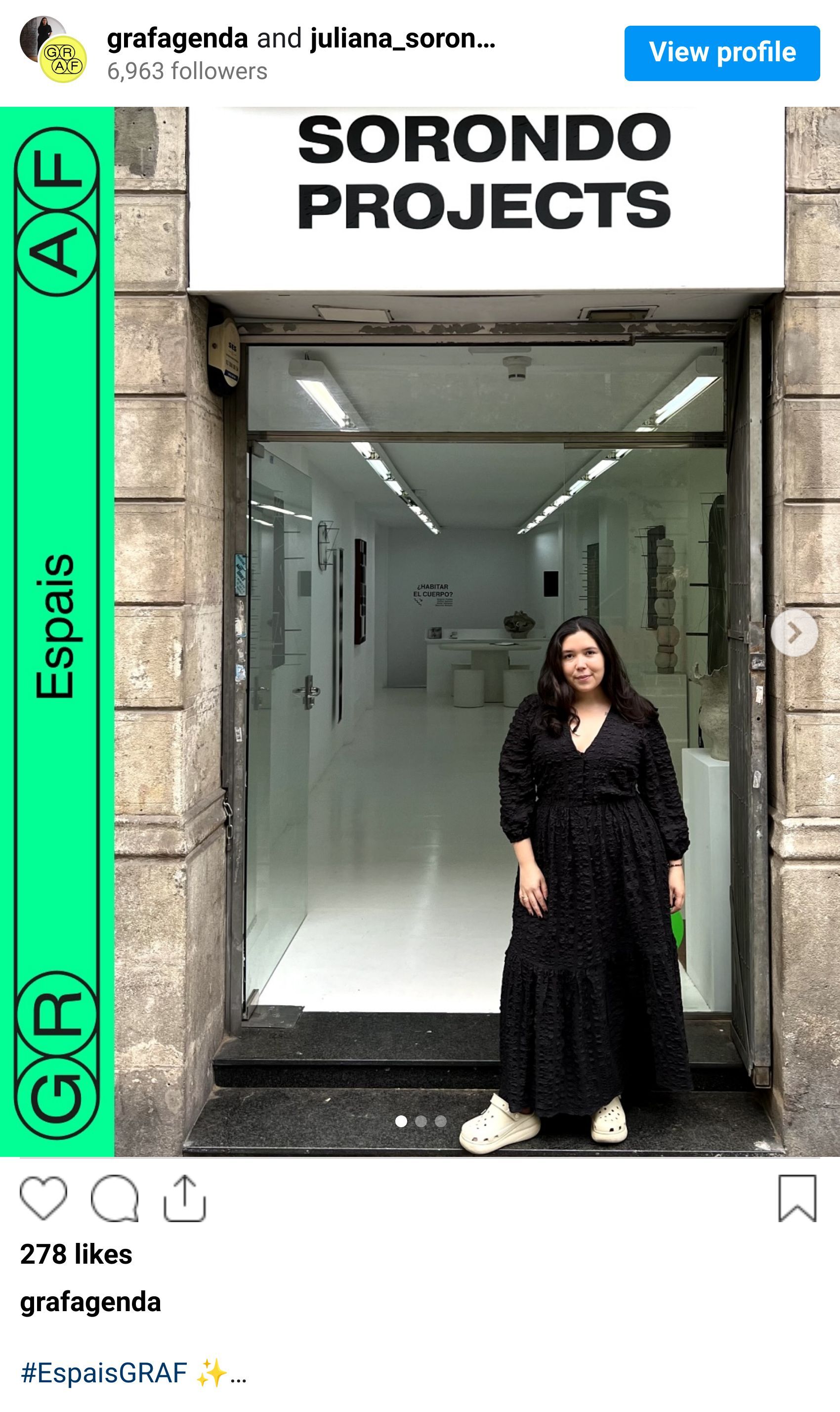
I wanted to take a moment to acknowledge the work of Venezuelan curator Juliana Sorondo, whom I had the pleasure of meeting at Photo London in May. Since founding Sorondo Projects in Barcelona last year, she’s already made a remarkable contribution to the visibility of Latin American and other international artists.
With a focus on artistic practices that engage with displacement, cultural memory and questions of belonging, Sorondo spent 2025 building an ambitious fair programme across Europe and the Americas, presenting at no fewer than six major international art fairs. Below are some highlights from Sorondo Projects’ freshman year, offering a glimpse of what is still to come.

Ligia y Maria José [Tejiendo El Petróleo] // Maria Elena Pombo// 2024// Venezuelan Crude Oil, Brown Alage Extract, Glycerin, Water // 91.4 x 182.9 x 5 cm. Zona Maco, Mexico City.
Zona Maco, Mexico City
The Weight of Identity featured works by Korean-Venezuelan artist Suwon Lee, Venezuelan artist María Elena Pombo and Mexican artist Luis Rentería.
Loop Lab Busan and Paris Photo
Suwon Lee presented Dictée Exilée at Loop Lab Busan, Korea’s first media art fair, in April, followed by Paris Photo in November with La Montaña Sagrada.

Photo London
Memoria Viva, featuring Venezuelan artists Silvana Trevale and Gabriel Pinto, both winners of the Nikon Emerging Photographer Award.
arteBA and ARTBO
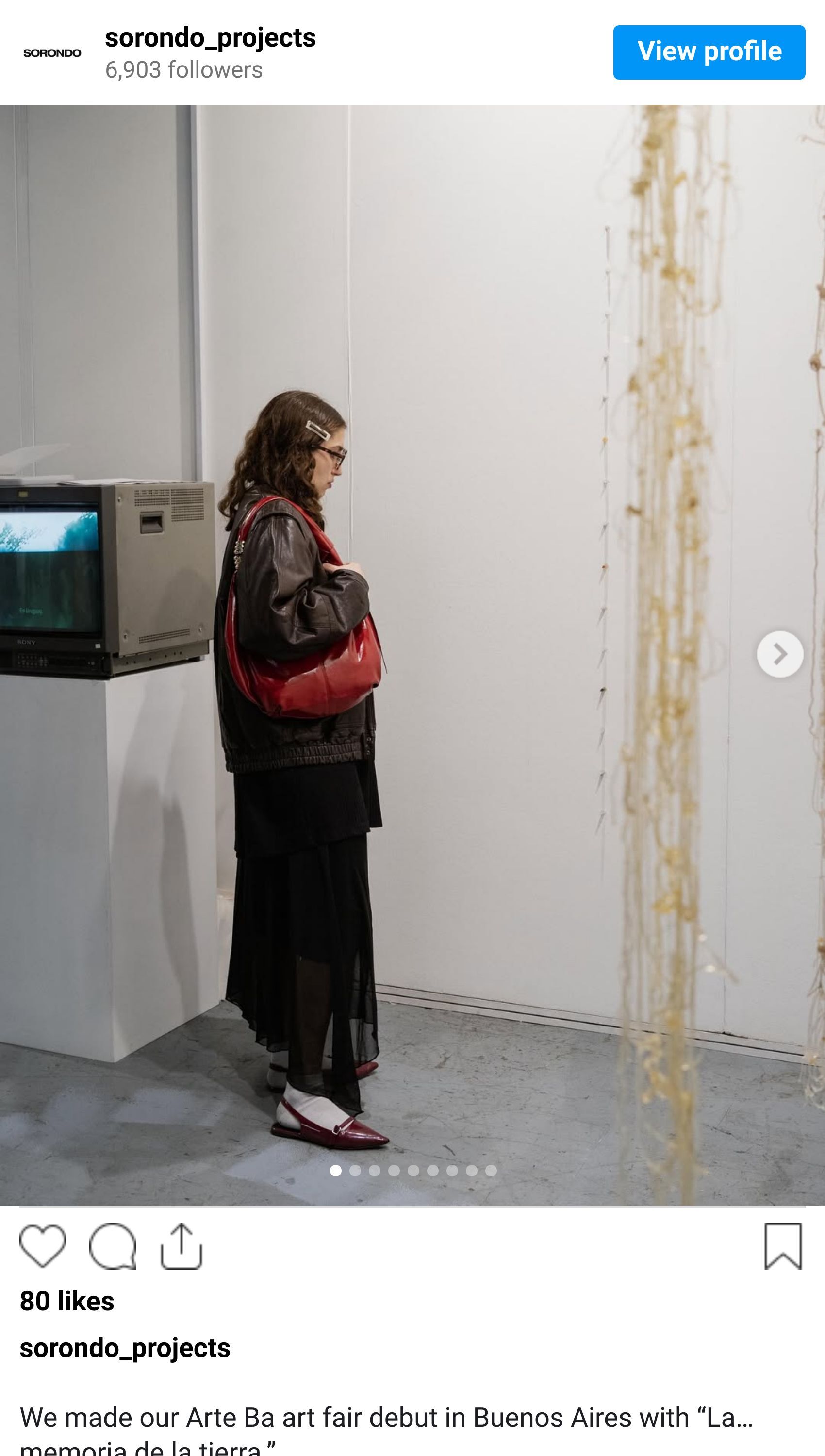
At arteBA in Buenos Aires, Sorondo presented La memoria de la tierra with Antonela Aiassa and María Elena Pombo. Later at ARTBO in Bogotá, Traces of Time: The Persistence of Matter brought together Cali-born artist Armando Mesías and Pombo.
Untitled Art, Miami Beach
The Politics of Appearance, featuring Venezuelan artist Angyvir Padilla, Salvadoran artist Emiliana Henríquez and Spanish artist Miranda Makaroff.“
What’s next: Sorondo is already gearing up for the 2026 edition with Russian artist Nikolay Morgunov, Argentine artist Antonela Aiassa a Rentería. Keep an eye on their socials for news!
Five female that artists didn’t get consacrated until later in life

Visual artist Cecilia Vicuña at the Guadalajara International Book Fair, in November 2022.Roberto Antillón (El País).
Reported by Ana Vidal Egea for El País, a number of women artists gained recognition only later in life, after decades of relative invisibility. Among them are Latin American artists Cecilia Vicuña, Olga de Amaral and Cossette Zeno.
Cecilia Vicuña, 78, a Chilean based in New York, received the Gold Award in the Icon category at the Art Basel Awards during Art Basel Miami Beach in December. The honour recognises not only Vicuña’s work, but also a generation of women whose contributions were long overlooked.
Cossette Zeno, from Santo Domingo, Dominican Republic, was among the “newly discovered” artists presented by Richard Saltoun Gallery in Miami. At 95, she was participating in an art fair for the first time. Trained in Paris in the 1950s with Eugenio Granell and André Breton, her career was sidelined for decades.
The gallery also featured Colombian textile artist Olga de Amaral, 93, born in Bogotá. Although her work gained international attention in the 1970s, her first major retrospective only took place in 2024 at the Fondation Cartier in Paris.
Other notable figures include Betye Saar, who at 99 was honoured with an Art Basel Award Medal this year. The Los Angeles–born artist, now recognised as a pioneer of Black feminist art and assemblage, spent much of her career without the institutional recognition her work deserved, despite having works at MoMA, the Met, the Whitney, and Tate Modern.
Similarly, Faith Ringgold received her first retrospective at the Museum of Contemporary Art Chicago in 2023 at age 93. She died two months later, highlighting the delayed nature of her institutional recognition.
—
Ernesto Neto’s Colossal Crocheted Instalations

Ernesto Neto’s work was ubiquitous this year. He is one of Brazil’s foremost contemporary artists, internationally celebrated for his installations and sculptures featuring organic forms, often monumental in scale, created from textiles and filled with materials such as polystyrene foam balls, sand and spices (Arte y educación).
They are colourful, beautiful and interactive, which is kind of the whole point. There is no academic subtext. Rather, he wants participants to move through, feel and even smell the works, encouraging them to become active participants.

At Le Bon Marché Rive Gauche in Paris, he presented La Serpent, a contemplative white-crochet installation. This was followed by Nosso Barco Tambor Terra at the Grand Palais, presented from June 5 to July 25 as part of the France–Brazil Season. The Rio native also took part in the Helsinki Biennial and unveiled a suspended knit installation at the Seoul Museum of Art.
Cadaver Fantasma by Andrew Roberts

In Artnet’s article “What Defined 2025? Curators Pick the Year’s Best Art”, one of the selected works was Cadáver fantasma by Tijuana-born artist Andrew Roberts. The piece, presented at the Museo Universitario Arte Contemporáneo (MUAC) in Mexico City, was chosen by Kit Hammonds, Chief Curator of Museo Jumex.
Hammonds dubbed the installation “both entertaining and disturbing”, yet in its sophisticated structure every element folds into the next in a repetition of fours.
Inspired by Roberts’ experience growing up in Tijuana in the early 2000s, the video installation constructs a fictional world in which four teenagers have survived a zombie apocalypse and now appear as witnesses to the remnants of a vanished society.
The artist draws on fictions shaped by capital and neoliberal logic to explore how commodities and video games link death to a spectral presence. Cadáver fantasma reflects on the disconnect between digital reality and its material impact on our bodies, projecting a hybrid future where the physical and the virtual merge.
On my radar lately…
More Art. Currently, the 36th Bienal de São Paulo, Not All Travellers Walk Roads – Of Humanity as Practice, is on view until 11 January 2026 at the Ciccillo Matarazzo Pavilion. Its curatorial concept is built around rethinking humanity as a practice and uses the estuary as a guiding metaphor, a meeting place of flows and encounters, drawn from Brazilian philosophies and the poem “Da calma e do silêncio” [Of Calm and Silence] by poet Conceição Evaristo.
Succint and brilliant trend reporting
Monthly insights by consultant and trend researcher Gaba Najmanovich. Exprimido de Tendencias explores everything from the universe of trends to how emotions shape consumption and design. It looks at innovative experiences, new aesthetics, social movements, design strategies, interesting materials and a wealth of inspiring data.
LATAM Data Insights
I recently came across this really mighty newsletter, Latinometrics. They focus on presenting data on tech, economy, taxes, trade and more from the region, in a very clean, visually engaging way. BTW, they’re offering annual subscriptions of only $29 until 31 December. I’m grabbing one now.
Tech
OpenAI launches ChatGPT Go in Mexico and the rest of Latin America. ChatGPT Go offers a lower-cost subscription (approx $6–7 USD) aimed at widening access to advanced AI tools, with sign-ups available directly through Rappi. (FashionNetwork). More on how tech and AI are affecting Latam in the next issue.
Independent Reporting
Latin American Insider is a newsletter by Paolo Manzo. With over twenty years of experience covering emerging markets, the Italian, São Paulo–based journalist has covered politics, economics, security and technology in Latin America, often in three languages: Italian, English and Spanish.
More people should now about
Drug trafficking, extortion, kidnapping’: the lawless rush for rare earth minerals in Venezuela. Guerrilla groups have seized control of mining areas, exploiting Indigenous people and fuelling environmental ruin on the border with Colombia. (The Guardian).
Thank you for making it this far! I will be back next week with more stories, ideas and discoveries from across the region.
Until then, take care and stay inspired.
Graciela.
GEN33 is a reader-supported publication. If you're liking it, tell a friend (or five).
My IG @gramartinm
