In partnership with

ADVERTISEMENT
Why is everyone launching a newsletter?

Because it’s how creators turn attention into an owned audience, and an audience into a real, compounding business.
The smartest creators aren’t chasing followers. They’re building lists. And they’re building them on beehiiv, where growth, monetization, and ownership are built in from day one.
If you’re serious about turning what you know into something you own, there’s no better place to start. Find out why the fastest-growing newsletters choose beehiiv.
And for a limited time, take advantage of 30% off your first 3 months with code LIST30.
Welcome to GEN33! Tracking shifts in the business and culture of Latin America’s creative industries.
I’m dedicating this issue to Bad Bunny’s much-awaited and widely discussed Super Bowl halftime show, and the many details and subtle political messages the Boricua artist wove into it.
Even with every possible analysis already written, I wanted to offer a Latin American perspective and share a few thoughts of my own, as well as impressive data from Launchmetrics, which claimed it was “the most powerful MIV-driving performance the Super Bowl has ever seen.”
I’ve also gathered a few stories from around the web, including the premiere of Aún es de Noche en Caracas, produced by Edgar Ramírez (it has rave reviews and is helpful for understanding the situation in Venezuela), highlights from Mexico’s Zona Maco, Wagner Moura’s Oscar nomination, and more.
Decoding Bad Bunny's Super Bowl XL Halftime Show

How amazing was that Halftime show? Fresh off a big Grammy win, the Puerto Rican star delivered a potent performance, replete with colour, symbolism and celebrity cameos, paying tribute to pan-American identity while sending a powerful message of unity.
Since the September announcement of his appointment to headline the Super Bowl, controversy had been brewing, with some deeming him “not American” despite his US citizenship as a Puerto Rican, and criticising him for singing almost exclusively in Spanish.
On Sunday, however, Benito Antonio Martínez Ocasio became the first male solo Latin artist to headline the halftime show and the first to perform his set entirely in Spanish.
Interestingly, some chose to embrace it rather than react with outrage. According to Teen Vogue, ahead of the show, Genius reported a 467% spike in page views for English translations of the album’s songs. Meanwhile, it was reported that during and after the broadcast, Duolingo noted a 35% week-on-week increase in Spanish-language learners after 140 million viewers tuned in; making it one of the most-watched Super Bowl halftime shows of the decade.
But beyond language and whether the show was “American enough”, what seems to have been lost on many is that, if anything, Bad Bunny’s journey — and the show itself — tells the story of the American dream: a humble kid, son of a truck driver and a teacher who made it big not just in the US but around the world.
At the four and a half minute mark, as violins begin to play, he says:
Buenas tardes, California. Mi nombre es Benito Antonio Martínez Ocasio y si hoy estoy aquí en el Super Bowl LX es porque nunca, nunca dejé de creer en mí. Tú también deberías creer en ti. Vales más de lo que piensas. Créeme.
“Good afternoon, California. My name is Benito Antonio Martínez Ocasio, and if I am here today at Super Bowl LX it is because I never, ever stopped believing in myself. You should believe in yourself too. You are worth more than you think. Believe me.”

Bad Bunny performing at the Super Bowl XL on Sunday February 8th.
Like his 2025 album Debí Tirar Más Fotos, which made history at last week’s Grammys as the first fully Spanish-language record to win Album of the Year, the performance was a love letter to Puerto Rico, layered with cultural and political meaning.
This tied into his broader message of reframing what ‘American’ actually means. As he closed, the 31-year-old said “God bless America” (in English), then named all of Latin America’s countries, moving from south to north — a subtle but pointed inversion of the usual geopolitical gaze — before ending with “And my motherland, Puerto Rico.”
He finished by lifting a football inscribed with “Together, we are America”; some interpreted that as a reminder that the United States itself is a multicultural, multilingual and irreducibly mixed nation. Behind him, a billboard read, “The only thing more powerful than hate is love.”
Here, I break down the details woven throughout the show, each layered with cultural and political meaning.
Ricky Martin was more than just a guest appearance

The great Ricky Martin is the OG of Spanish-language musical crossover. His 1999 hit Livin’ la Vida Loca, a pop-forward tune in Spanglish, was a global success. The song became his biggest hit and one of the best-selling singles of all time. Even then, he never had a stage like the Super Bowl.
Livin’ la Vida Loca followed his 1998 World Cup song, La Copa de La Vida. At the time, he was told he needed to sing in English to appease English-speaking audiences.
Both tunes opened the door to what came next: Shakira, Luis Fonsi’s Despacito, Daddy Yankee, Pitbull and others. Indeed, Benito is not one to forget his predecessors. During the show, the singer briefly paid homage to reggaetón from his island, playing snippets of “Dale Don Dale” and “Gasolina” by Don Omar and Daddy Yankee.
However, the song Martin performed, Lo que le pasó a Hawaii, was perhaps the strongest political message of the night. Translating to “What happened to Hawaii”, the song comments on Puerto Rico’s and Hawaii’s shared colonial histories; it can be interpreted as a warning about Puerto Rico becoming a state, with concerns around displacement, overmilitarisation and overtourism.
A little side note: Beyond evoking Bad Bunny’s cover of DTMF, those plastic chairs are emblematic of any small town in Latin America. They could belong to a seaside chiringuito, an empanada stand or any bodeguita.
Lady Gaga’s Dress and Stying Details

Lady Gaga and Bad Bunny performing at the Super Bowl XL Halftime Show
It’s no secret that Bad Bunny and Lady Gaga are huge fans of each other. Gaga reversioned her song Die With a Smile in salsa and played with Los Sobrinos, the young Puerto Rican band that has worked with Benito since the production of DeBÍ TiRAR MáS FOToS (DTmF). Having Lady Gaga sing was also a way of saying: America is the whole continent.

Gaga’s sky blue, ruffled dress by Dominican-American designer Raul López, founder of Luar, echoed the hue of a historical Puerto Rican flag associated with independence. She also wore Chopard earrings and a statement brooch by Piers Atkinson, featuring Puerto Rico’s official flower, Flor de Maga. (Maga! how ironic).
The Star-Studded Casita

La Casita, Bad Bunny performing at the Super Bowl XL.
During his 31-show residency in San Juan, Puerto Rico, Bad Bunny invited figures from across entertainment to join him in “La casita”, a replica of a typical Puerto Rican concrete home. He repeated the concept on Sunday, at the Super Bowl halftime show.
Cardi B, Karol G, Pedro Pascal, Jessica Alba and Young Miko were some of the most recognisable faces. Others, perhaps less known beyond industry insiders, included influencer Alix Earle, businessman David Grutman and Venezuelan baseball player Ronald Acuña Jr.

TELENOVELA STYLE

Screenshot of the opening credits.
The opening credits read: “Benito Antonio Martínez Ocasio presenta El Espectáculo de Medio Tiempo del Súper Tazón.” This alludes to the telenovela format and typography, emulating what would have been a sort of “Televisa Presenta”, followed by the novela title and its opening vignettes.
The choice of Daytime. Nearly all Super Bowl halftime shows are staged after dark (reportedly only seven in total so far). Two of the most recent exceptions being the Super Bowl 50 (Coldplay, Beyoncé and Bruno Mars) and Super Bowl 56, with Dr. Dre alongside Snoop Dogg, etc.
For this show, a daytime performance made sense. It allowed the colours to register fully and conveyed the warmth of a close-knit community and the island joy of Puerto Rico. Benito and probably the producers intended to make it feel more like a cinematic mise en scène, instead of a high-wattage stadium concert.
Sugar Cane Plantations & Colourful Characters

Benito first emerges from a recreation of sugar cane fields, the workers wearing pavas, brimmed straw hats traditionally made from the leaves of the Puerto Rican hat palm. That was a broader comment on the colonial labour of sugar cane harvesting that built Puerto Rico’s economy well into the 20th century. Other Caribbean islands relied heavily on the trade too.
That harsh reality was then contrasted with a series of vignettes that could have unfolded in any coastal town across the region: the coco frío stand (who doesn’t want cool coconut water under the scorching Caribbean sun), the old men playing dominoes, the nail salon, the jewellery salesman, a piragua cart serving shaved ice with fruit-flavoured syrup (in Venezuela we call that raspao’).
Make no mistake, as a user @maobarraza said on X, “Bad Bunny’s halftime show was loaded with symbolism,” noting that the taco stand was called “Villa’s Tacos,” referencing Pancho Villa, the only person to have ever invaded the United States with his División del Norte. “Great one, Benito,” the user quipped.
Even the child asleep on a row of chairs at the wedding, which was, in fact, a real wedding. “That scene in Benito’s halftime show… the little kid asleep on the chairs at the wedding… Total flashback to every family party my Cuban parents and grandparents took me to as a kid. That was spectacular,” wrote user @ChristyChirinos.
🥊 The two boxers who appeared on stage were rising prospects Emiliano Vargas and Xander Zayas. Vargas, the son of former world champion Fernando Vargas, is one of the most closely watched Mexican-American talents in the sport. Zayas, fighting out of New York, has quickly become one of Puerto Rico’s most promising young contenders.

Lincoln Fox, the child actor at the Super Bowl LX.
Meanwhile, the child to whom Bad Bunny handed the Grammy was not Liam Ramos, who recently made headlines after being detained by ICE, but a young actor, Lincoln Fox. The moment was as a symbolic gesture, evoking his own childhood dreams of watching award shows and imagining himself on that stage one day.
NuevaYol
After the wedding scene and Lady Gaga, Bad Bunny pays homage to the fusion of New York and Puerto Rican culture. A replica of a barbershop and a bodega called La Marqueta appears on stage, and the iconic Toñita, owner of the Caribbean Social Club in Brooklyn, emerges to serve him a drink from behind the bar.
“Un shot de cañita en casa de Toñita y PR se siente cerquita,” he sings. Toñita’s Caribbean Social Club is one of the last surviving Puerto Rican social clubs in New York, a pillar of community, identity and cultural pride.
Electric Distribution Poles

Near the end of the show, Bad Bunny climbed a utility pole and sang from the top while dancers scaled nearby power structures with sparks flying around them. It was a nod to Puerto Rico’s decade-long electrical outages and infrastructure challenges. The issue has only worsened since Hurricane María in 2017, with successive governments doing little to fix it. Another curious detail, the artist refused to wear a harness for the stunt.
Ocasio 64 shirt
The shirt, part of a custom look created by Zara for the occasion, prompted multiple interpretations online. As reported by Rolling Stone, it was in fact a tribute to his late uncle, Cutito, who passed away two years ago. Born in 1964, Cutito moved to the United States at 17 and became a devoted fan of the San Francisco 49ers, whose home stadium hosted Super Bowl 60, where Bad Bunny performed. The artist always dreamed of taking his uncle to a Super Bowl but never had the chance.
The more I dug, the more details and layers of symbolism emerged, from the sapo concho, a recurring figure in BB’s imagery and a reference to Puerto Rico’s endangered crested frog, to the performance by renowned Nicaraguan conductor Giancarlo Guerrero, who led a group of talented young violinists.
To round out this section, here are some fresh figures from Launchmetrics offering further insight into Bad Bunny’s show:
The Impact of the Benito Bowl in Numbers
According to Launchmetrics, a data analytics firm, Bad Bunny mentions drove 39% of total Super Bowl coverage, generating nearly $170M Media Impact Value (MIV) in just 12 hours after broadcast. For comparison, in 2023 Rihanna drove 27% of Super Bowl coverage in the same time frame; Bad Bunny nearly doubled her numbers.
The brands he wore: Zara generated $3.1 million in MIV, Adidas $1.6 million and Audemars Piguet $609,000.
The single highest-performing post of the entire event came from the NFL itself, spotlighting the halftime performance and generating $2 million in MIV from one post alone.
What is MIV exactly? Media Impact Value® (MIV®) is a powerful metric that assigns a monetary value to media mentions across social media, online publications and other channels—helping brands quantify the impact of media exposure. Launchmetrics explains it in more detail here.

“It’s all in the data–Bad Bunny’s halftime show was more than a historic moment; it was the most powerful MIV-driving performance the Super Bowl has ever seen.”
Newsround
First Venezuelan NFL Player
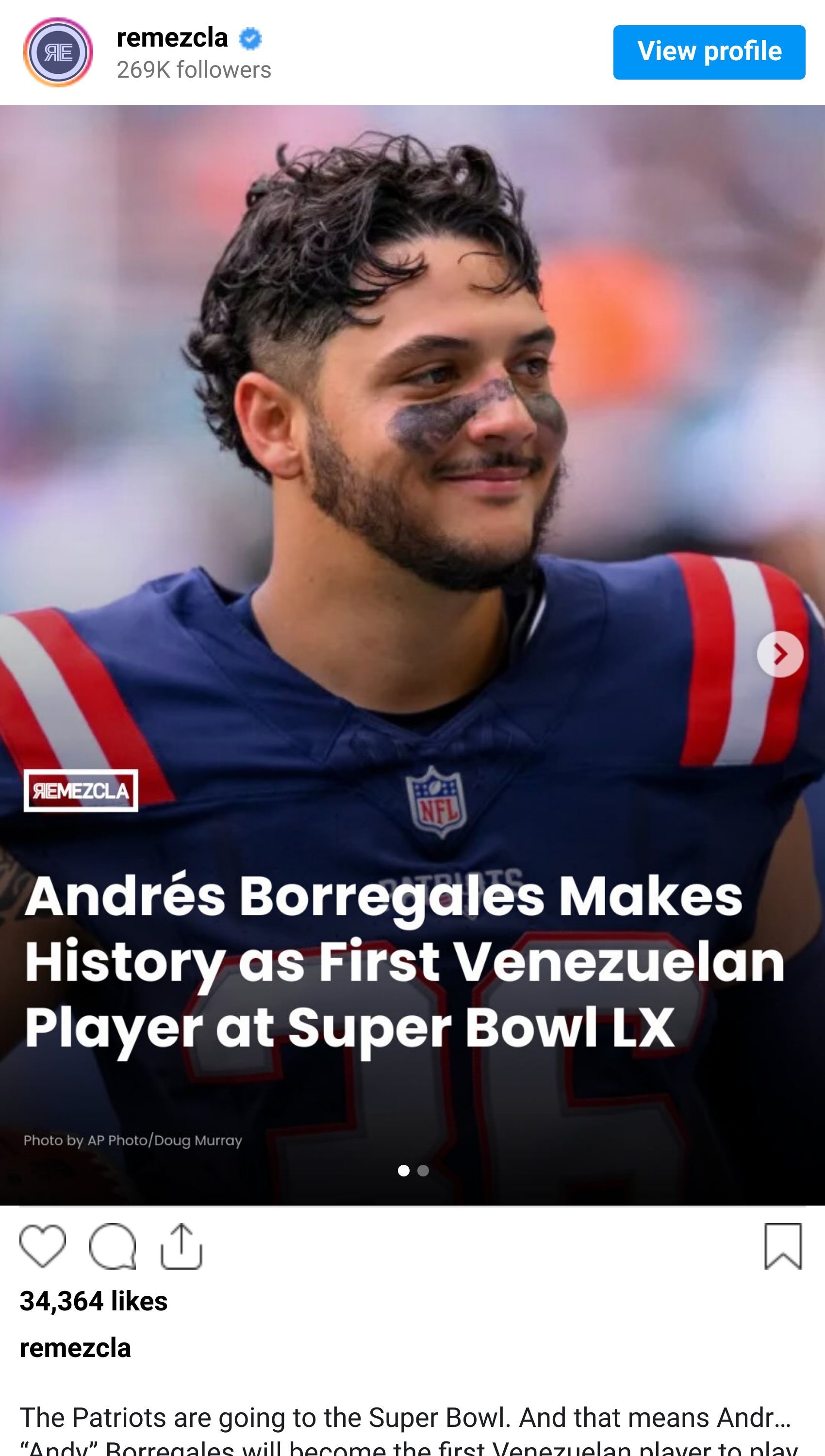
Borregales grew up Miami, Florida after his family emigrated from Venezuela when he was a toddler. He eventually become a standout kicker at the University of Miami before being drafted by the New England Patriots in the sixth round of the 2025 NFL Draft.
Although New England reached Super Bowl LX, they were defeated 29-13 by the Seattle Seahawks at Levi’s Stadium on Sunday. Borregales was on the roster and officially active for the game, making at least one extra-point attempt, but did not have a field-goal attempt in the contest. (News Americas Now).
ART
Highlights from Zona Maco 2026
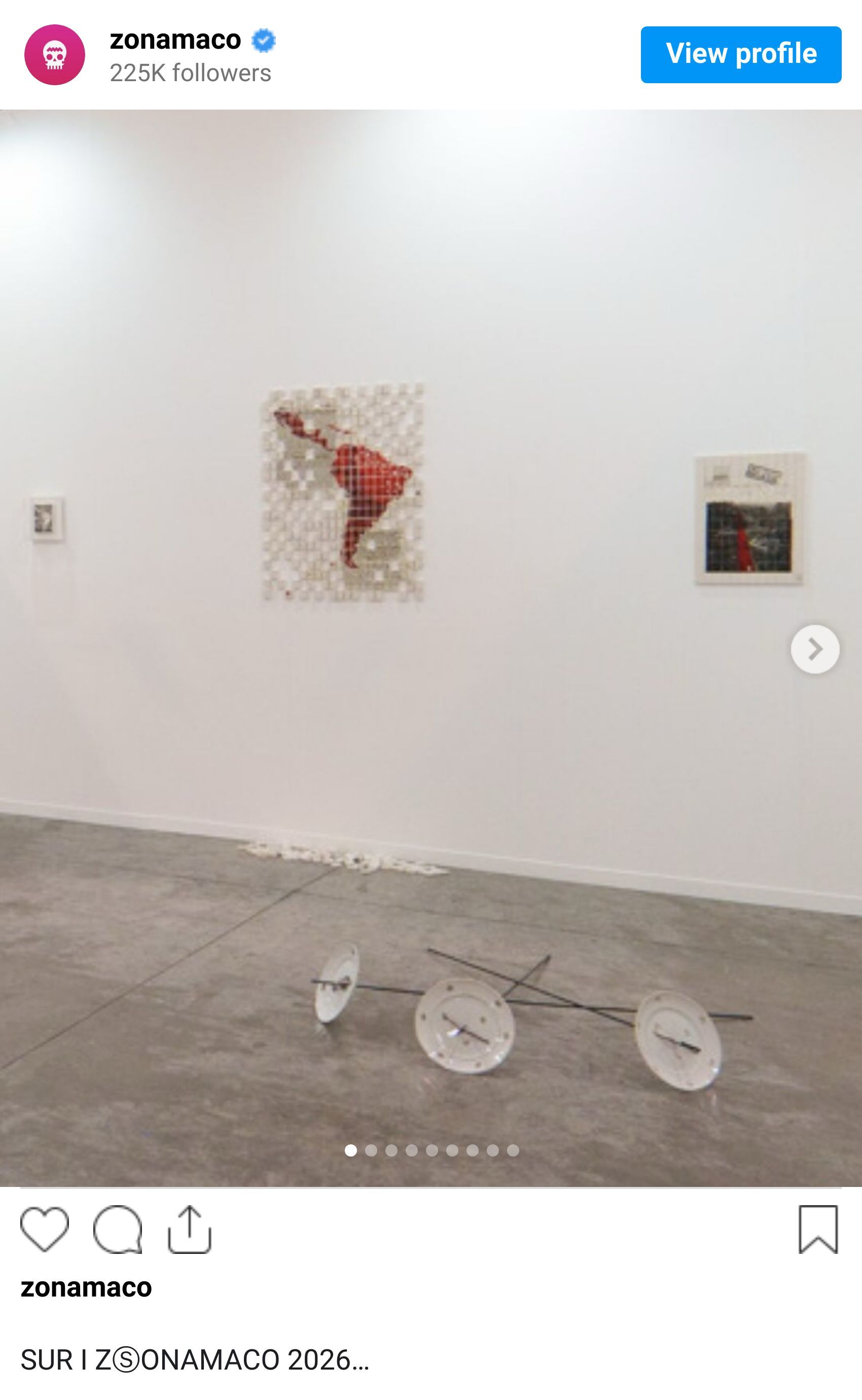
Twenty-two years into Zona Maco, the fair that transforms Mexico City into one of the busiest art destinations in the world. It remains Latin America’s largest and most influential art fair, which ran from February 4 to 8, 2026, at the Centro Citibanamex in Mexico City.
Over the years, the event has evolved from a simple gathering of the city’s leading artists into an ambitious platform where galleries unveil their most considered exhibitions, attracting collectors and curators from around the world and shaping the global art market.
This year, the fair introduced a new section, Forma, dedicated to exploring the intersection between art and design. Here are some of this edition’s highlights:
Patricio Tejedo at Terreno Baldío. Beeswax, marble, volcanic stone and crushed tezontle used to create sculptural works rooted in natural materials.
Karla Ekaterine Canseco at Murmurs. Petroleum-infused sculptures exploring geopolitics, ecology and myth.
Nicolás Bonilla and María Roldán at SGR Galería. Mineral-based sculptures and blown glass paired with natural rock formations.
Alejandro Almanza Pereda at Curro. Terracotta vessels filled with concrete, partially broken to reveal interiors.
Lucia Tallová at Zilberman Gallery. Fragmented Doric columns with incised images of Venus, addressing monumentality and the male gaze.
Galeria Lume (“Before It Fades”). Hal Wildson and Osvaldo Gaia examining memory, protest and US intervention in Latin America.
José Gamarra at Mariane Ibrahim. Politically charged paintings confronting imperialism and neo-colonialism.
Angela Burson at Hashimoto Contemporary. Narrative paintings with concealed faces and enigmatic details.
(Artnews)
FILM
It is Still Night In Caracas

The dramatic thriller It Is Still Night in Caracas, directed by award winning directors Mariana Rondón and Marité Ugás, is based on the novel The Daughter of the Spanish Woman by Karina Sainz Borgo, portraying violence and scarcity in Venezuela, according to Cine PREMIERE. The film, co-produced by Edgar Ramírez, began screening in cinemas from early February 2026, and it was part of the Venice Spotlight at the Venice Film Festival 2025.
Set in Caracas during the political protests of 2017, the story follows Adelaida after her mother’s death. When a corrupt militia takes over her home, she is forced to hide in a neighbour’s flat to survive. What begins as a simple fight for survival unfolds into a tense, gripping drama filled with suffocating moments and real danger.
The film blends stark realism with a strong sense of claustrophobia, reflecting the directors’ clear artistic vision. Natalia Reyes delivers a powerful performance, capturing both vulnerability and strength. The film has received excellent reviews for its intensity, realism and emotional depth.
t’s worth noting that this kind of armed violence by regime-associated groups is still ongoing after Maduro’s capture on 3 January. While there appears to be an opening for democracy, Venezuela is still not free from the regime installed by Chávez and continued by Maduro.
See here for where to watch in Latin America. For the rest of the world, some reports say it will be available for streaming on Netflix later in the year.
FILM
Wagner Moura’s Defining Awards Moment

The Secret Agent has emerged as one of the season’s defining critical successes, moving seamlessly from festival acclaim to awards-season frontrunner. The film won Wagner Moura Best Actor at Cannes and a Golden Globe, making him the first Brazilian performer to win the accolade in the drama category. The film has since gone on to receive multiple Academy Award nominations, including Best Picture and Best International Feature, with Moura also nominated for Best Actor.
While many international audiences still associate Moura with his portrayal of Pablo Escobar in Narcos, this performance marks a decisive pivot. In The Secret Agent, directed by Kleber Mendonça Filho, Moura plays Armando, a former professor navigating the suffocating political climate of Brazil’s military dictatorship. The neo-noir historical thriller follows his attempt to evade persecution while quietly resisting an authoritarian regime.
The stellar supporting cast reinforces the film’s gravitas, including Carlos Francisco, Maria Fernanda Cândido and Udo Kier in his final screen role. Moura has been praised for a restrained, interior performance that anchors the project, widely regarded as his finest to date.
For his part, director Kleber Mendonça Filho commended Moura at the International Film Festival Rotterdam, describing him as a generous star. (Variety).
Photography
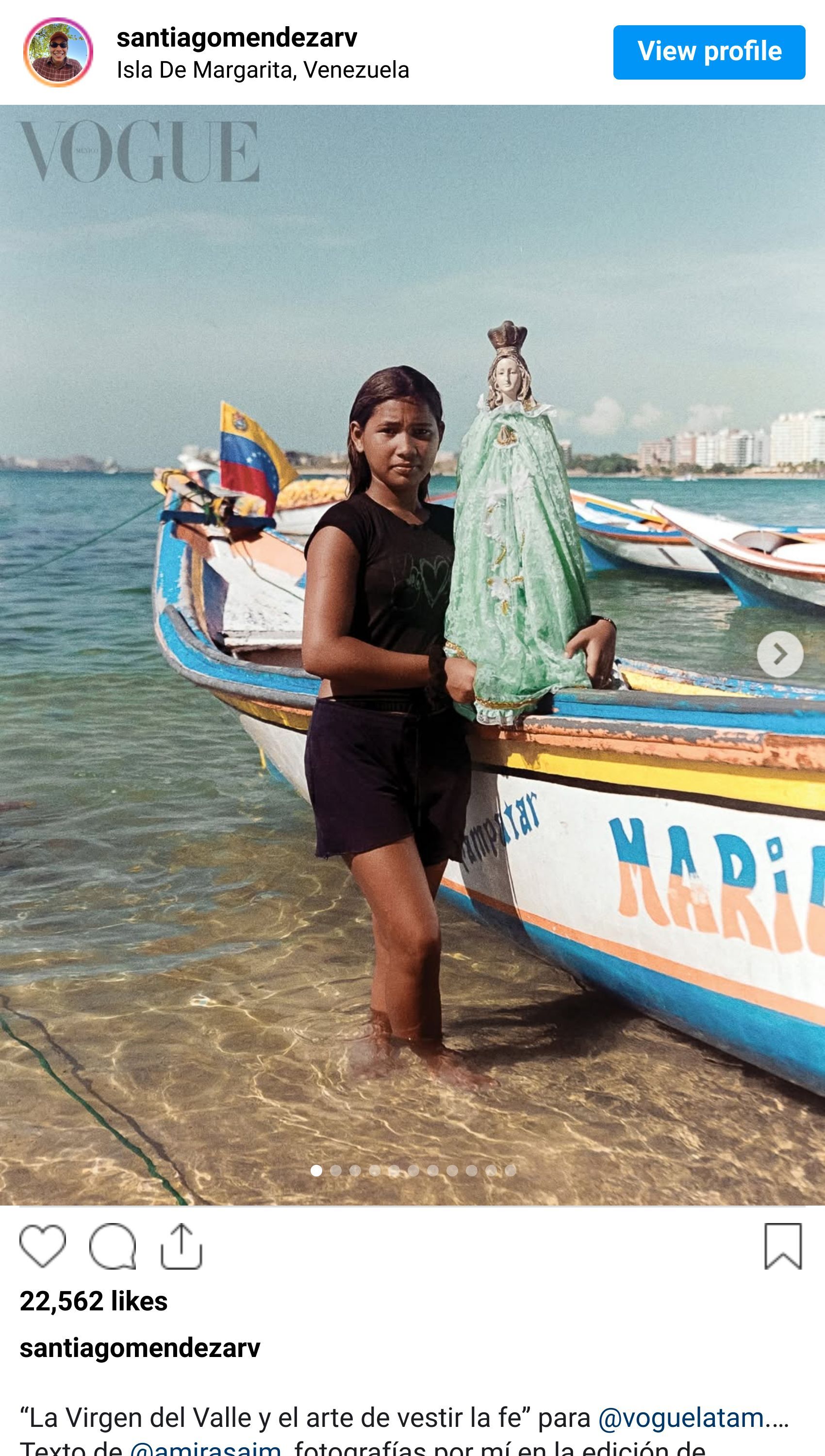
A moment to appreciate the beautiful work of Venezuelan photographer Santiago Méndez. La Virgen del Valle and the art of dressing faith for @voguelatam, December 2025. An intimate look at a devotion in Margarita that is culture, image and community. In this shoot, an island-native brand, Tarbay by Ana Sofía and Martha Tarbay, took part in this celebration of faith and craftsmanship, bringing their distinct visual language to a tradition that blends spirituality with identity.
“Endless thanks to the island and its devotees for allowing me to witness so closely a faith that is culture, image and community,” said Méndez.
¡GRACIAS!
Thank you for making it this far! I will be back next week with more stories, ideas and discoveries from across the region.
Do share if you like GEN33 and keep an eye out for upcoming issues.
Until then, take care and stay inspired.
Graciela.
Give us a follow!
GEN33 is a reader-supported publication. If you're liking it, tell a friend (or five).
Instagram @GEN33Mag
LinkedIn Page GEN33Mag
My IG @gramartinm
Apologies for any typos, this newsletter was written by a human.
Until next time!
GEN33
